

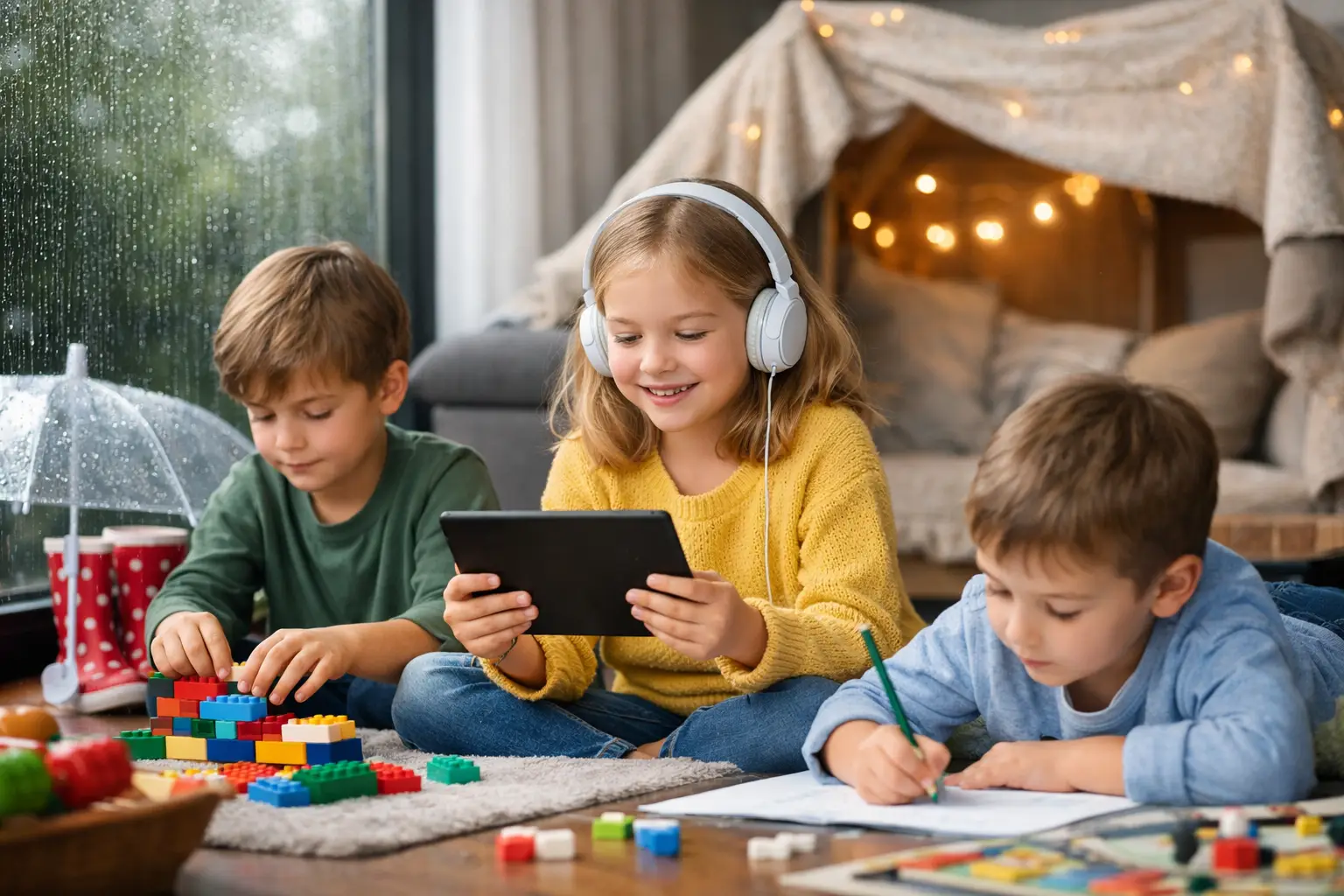
The rain starts, the shoes pile up by the door, and suddenly the whole day feels smaller. When you need rainy day activities kids will actually stick with, the goal is not to create a picture-perfect afternoon. It is to lower the stress, give your child something meaningful to do, and help everyone make it to bedtime in one piece.
What works best with rainy day activities kids usually depends on two things: your child’s energy level and your own capacity. Some days call for movement and noise, while other days, everyone needs quiet play and a snack within reach. A good plan leaves room for both.
How to choose rainy day activities kids will enjoy
Parents often feel pressure to keep a rainy day packed with entertainment, but children usually do better with a rhythm than a constant stream of new ideas. Start by noticing what your child seems to need. If they are climbing the couch and bothering siblings, they probably need gross motor play. If they are melting down over tiny things, a calmer sensory activity may go better.
It also helps to think in short blocks of time. One activity does not need to fill the whole day. Twenty focused minutes can reset the mood, especially for toddlers and preschoolers. School-age kids may stay with something longer if they have a clear goal, like building a fort, baking muffins, or putting on a puppet show.
Must Read: Top Things to Do on a Rainy Day for Moms and Kids
Active rainy day activities kids can do indoors
When children are stuck inside, their bodies often tell the story before their words do. They bounce, crash, argue, and circle the kitchen. Indoor movement does not have to mean a huge playroom or expensive equipment.
A simple obstacle course is usually enough to turn the energy in a better direction. Use couch cushions to hop across, masking tape for balance lines, and a laundry basket for soft toy tosses. Younger kids enjoy repetition, so keeping the course basic is often better than making it elaborate. Older children may like timing themselves or redesigning the course between rounds.
Dance breaks work for almost every age, especially when attention is fading. Pick three or four songs and call it a dance party instead of expecting a full hour of activity. That small shift matters. Short bursts feel manageable for you and more fun for your child.
Indoor scavenger hunts are another strong option because they combine movement with problem-solving. For little ones, ask them to find something red, something soft, and something round. For older kids, give clues or categories. If siblings are involved, this can go very well or turn competitive fast, so it helps to decide ahead of time whether they are working together or separately.
Creative activities that stretch the afternoon
Creative play is especially helpful on rainy days because it slows children down without making them feel bored. It gives their hands something to do, which often helps their emotions settle too.
Art does not need to be complicated to feel exciting. Set out paper, crayons, stickers, and tape, then offer a simple prompt like drawing a rainy neighborhood, making a pretend menu, or designing a dream bedroom. Open-ended supplies usually go further than crafts with too many steps, especially if you are helping more than one child at once.
If your child likes stories, try a make-your-own book activity. Fold a few sheets of paper together and let them create a character, a problem, and a happy ending. Younger kids can dictate while you write. Older kids can add speech bubbles, labels, and chapters. This works well because it blends literacy, imagination, and quiet focus.
Play dough, kinetic sand, or even a bowl of dry rice with scoops can hold a child’s attention longer than many parents expect. Sensory play is not always mess-free, and that trade-off is real. But if you put down a towel or tray first, the cleanup is usually worth the calm it creates.
Rainy day activities kids can do with everyday household items
Some of the best at-home activities come from using what is already around you. That matters on long weeks when buying new supplies is the last thing you want to deal with.
Blankets and chairs can become a fort, and forts are one of those activities that keep giving. First there is the building, then the decorating, then the pretend play, then the snack inside the fort. A flashlight and a small stack of books can stretch it even further.
Painter’s tape or masking tape can also save a rainy afternoon. Tape roads on the floor for toy cars, make hopscotch squares in the hallway, or create a line maze to follow from room to room. The appeal is simple: it changes the space without requiring much setup.
In the kitchen, a muffin tin plus random small objects can become a sorting game for toddlers and preschoolers. Buttons, pom-poms, crayons, or cereal pieces all work, as long as they are age-appropriate and safe for your child. For older kids, challenge them to invent a game using only five household items. Giving them the role of creator often keeps them engaged longer than handing them an activity outright.
Must Read: Top Rainy Day Activities for Moms and Kids to Enjoy
Quiet rainy day activities for overstimulated afternoons
Not every rainy day needs high energy. Sometimes the weather feels heavy, your child is tired, and the house needs everyone to come down a level.
Audiobooks or read-aloud time can shift the tone of the entire day. If your child struggles to sit still for books, let them listen while coloring, building with blocks, or cuddling under a blanket. Quiet does not have to mean perfectly still.
Puzzles are useful here too, especially if your child likes concrete tasks. Some children find them soothing because there is a clear beginning, middle, and end. Others get frustrated if the puzzle is too hard, so matching the challenge level matters.
A simple rest basket can help younger children reset without framing it as punishment or forced naptime. Fill it with board books, stuffed animals, a water bottle, and one soft sensory item. Even ten minutes in a calm corner can make the next part of the day easier.
Practical rainy day activities kids can learn from
Parents often want activities to be fun and worthwhile, and that is reasonable. The good news is that many everyday rainy day ideas naturally build skills without needing to feel like school.
Baking is a strong example. Measuring, pouring, stirring, and waiting all support early math, language, and self-regulation. It can be messy and take more patience than expected, especially with toddlers, but older preschoolers and school-age kids often rise to the occasion when given a real job.
Simple science experiments can also make a gray day feel interesting. Try sink-or-float with kitchen items, make a baking soda reaction, or test which household object rolls fastest down a cardboard ramp. Children do not need a perfect explanation of every result. Often, the learning comes from asking what they think will happen next.
Even chores can become part of the plan if you present them the right way. A sock-sorting race, toy wash station, or child-sized sweeping job gives kids structure and a sense of contribution. Not every child will love this idea, and some will protest no matter how playful you make it. Still, many children respond well when they feel included instead of redirected all day.
Making rainy day activities kids enjoy easier on parents
A rainy day can feel long not because children are home, but because parents are carrying the whole mental load of it. You do not need to perform your way through the weather.
Try rotating between active play, snack, quiet play, and help-yourself activities. That rhythm gives children something to expect and gives you small pockets to breathe. If one activity flops after five minutes, that does not mean the day is ruined. It just means your child needed something different.
It also helps to keep a basic rainy day shelf or bin if indoor days are common in your season. A few coloring supplies, tape, puzzles, old magazines, sensory tools, and card games can make a big difference when everyone is already restless. Mom Kid Friendly readers know this kind of preparation is less about being extra organized and more about protecting your own energy.
If you have multiple children, do not assume every activity needs to be shared. Sometimes the kindest choice is setting one child up with blocks while another paints at the table. Togetherness is wonderful, but so is reducing conflict.
And if screen time ends up being part of the day, that is not failure. It is one tool among many. What matters most is using it thoughtfully and balancing it with connection, movement, and rest where you can.
A rainy day at home does not have to be magical to be good. If your child laughed, moved their body, made something, or found comfort next to you while the weather passed, that day did its job.
Must Read: Top Indoor Activities for Kids to Spark Creativity and Fun
Frequently Asked Questions
What are the best rainy day activities kids can do at home?
The best rainy day activities kids can do at home include obstacle courses, blanket forts, scavenger hunts, baking, puzzles, art projects, and sensory play.
How do I keep kids busy indoors on a rainy day?
Start with short activity blocks. Mix active play, snacks, quiet time, and creative play so kids do not get bored or overwhelmed.
What are easy rainy day activities for toddlers?
Toddlers often enjoy sorting games, play dough, board books, music, simple dance breaks, toy washing, and safe sensory bins.
What are good rainy day activities for preschoolers?
Preschoolers usually enjoy indoor scavenger hunts, pretend play, drawing, forts, puzzles, baking, and simple science experiments.
How can kids burn energy indoors when it rains?
Kids can burn energy indoors with dance parties, cushion obstacle courses, hallway hopscotch, balance lines, and soft toy toss games.
What quiet activities help kids calm down on rainy days?
Quiet rainy day ideas include audiobooks, puzzles, coloring, reading, rest baskets, block play, and cuddling with a favorite stuffed animal.
Are screen time activities okay on rainy days?
Yes, screen time can be part of a rainy day plan when used with balance. Add movement, creative play, snacks, and rest around it.
What rainy day activities use household items?
Blanket forts, tape roads, muffin tin sorting, cardboard ramps, sock sorting, and kitchen science games all use simple household items.
How can parents make rainy days less stressful?
Parents can make rainy days easier by rotating activities, preparing a small rainy day bin, and keeping expectations realistic.
Why do kids need movement on rainy days?
Kids need movement because indoor days can make them restless. Active play helps them release energy, focus better, and reduce arguments.
