

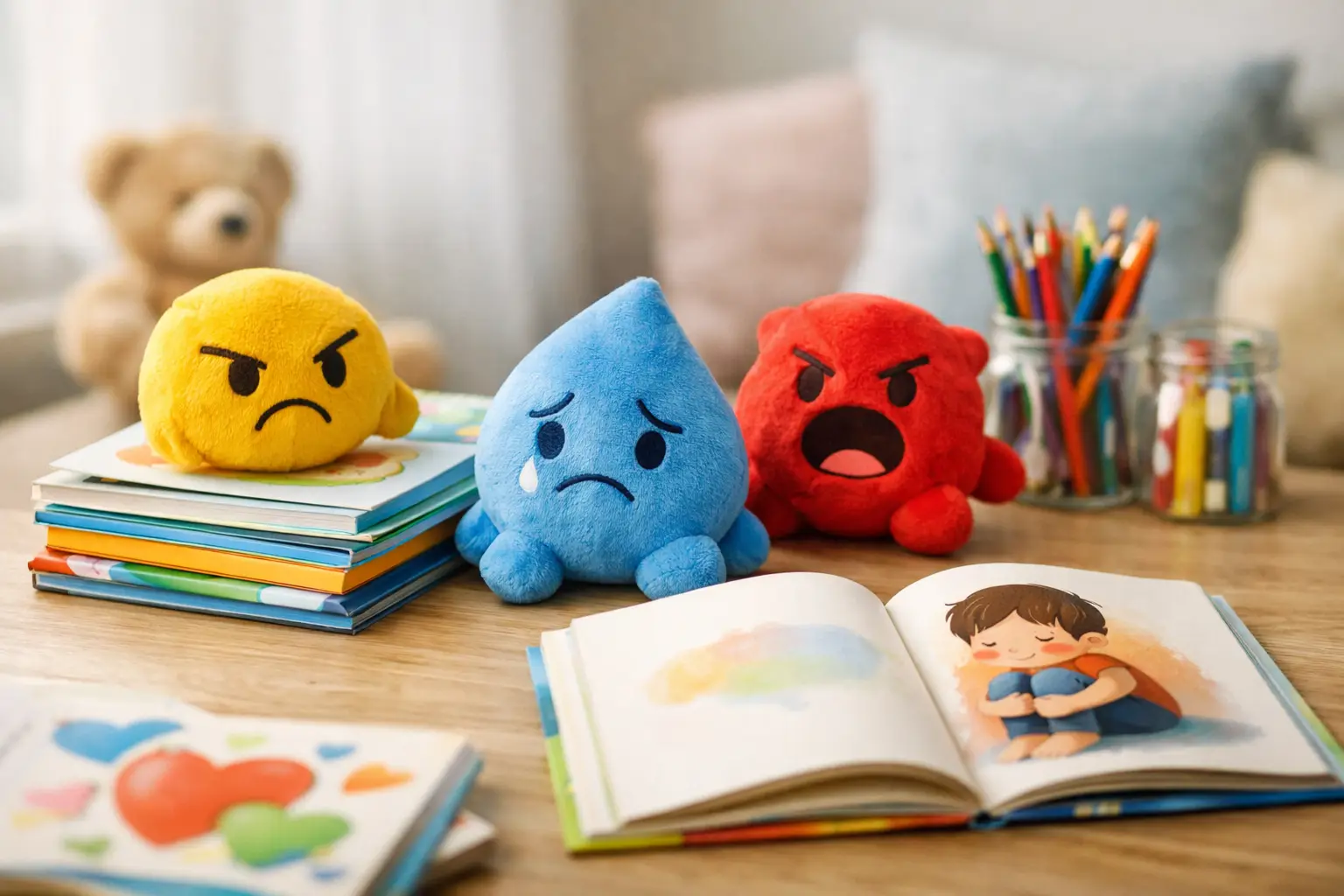
A child who melts down because their socks feel wrong is not giving you a book-report opportunity. They need support in the moment. But when the room is calm again, stories can give both of you words for what happened. The best books about big feelings help children recognize emotions without treating them as bad behavior to fix.
A good feelings book will not stop every tantrum, worry, or sibling argument. What it can do is make those moments less mysterious. It gives children a familiar character, a simple phrase, or a picture they can return to when they are overwhelmed – and gives parents an easier way to begin a caring conversation.
How to choose books about big feelings
Look for a book that matches your child’s age and the feeling showing up most often at home. Toddlers and preschoolers usually benefit from clear pictures, short language, and repeated words. Early elementary kids may connect more deeply with a character who makes a mistake, feels left out, or worries about something they cannot control.
It also helps to choose books that do more than name a feeling. The strongest stories make room for the emotion, show a child being understood, and offer a realistic next step. That might be taking a breath, asking for help, sitting close to someone, or simply waiting for the feeling to pass. There is a trade-off, though: a very direct book can be useful for teaching emotional vocabulary, while a story-driven book may feel less like a lesson and invite more natural discussion. Many families do well with a mix of both.
12 best books about big feelings for kids
1. The Color Monster by Anna Llenas
This visual story sorts feelings into colors, helping young children see that happiness, sadness, anger, fear, and calm can feel mixed up inside. The pop-up format is especially engaging for preschoolers, and the color language can become useful at home: “Are you feeling a little red angry right now?” Keep in mind that not every child experiences emotions in neat categories, so use the colors as an opening, not a test.
2. The Rabbit Listened by Cori Doerrfeld
When Taylor’s carefully built creation is knocked down, a parade of animals arrives with advice that does not help. The quiet rabbit does something better: it stays. This is a gentle, powerful choice for children dealing with disappointment, grief, anger, or a problem that cannot be solved right away. It also offers a lovely reminder to parents that connection often comes before solutions.
3. In My Heart: A Book of Feelings by Jo Witek
Bright illustrations and short descriptions make this an accessible introduction to many emotions, including shy, brave, happy, and angry. The language focuses on how feelings can show up in the body, which is valuable for children who say “I don’t know” when asked what is wrong. Read one or two pages at a time with younger kids rather than rushing through every feeling in one sitting.
4. The Feelings Book by Todd Parr
Todd Parr’s bold, playful style sends a simple message: every feeling is okay. The book is especially helpful for toddlers and preschoolers because it normalizes experiences such as feeling scared, silly, jealous, and proud without asking children to explain themselves perfectly. Its simplicity is the strength, although older children may want a story with more emotional depth.
5. When Sadness Is at Your Door by Eva Eland
Sadness appears as a quiet blue visitor in this tender picture book. Rather than telling children to cheer up, the story shows them that sadness can be noticed, carried, and eventually softened by care. It is a thoughtful choice after a hard day, a move, a friendship hurt, or a loss. Parents can use it to model a reassuring truth: sadness belongs, and no one has to hold it alone.
6. Grumpy Monkey by Suzanne Lang
Jim Panzee insists he is not grumpy, even as everyone around him can clearly see that he is having a rough day. The humor lands well with preschoolers and young elementary children, especially those who resist being told how they feel. It makes space for bad moods without excusing unkind choices. After reading, you might ask, “What helps when you feel grumpy but do not want to talk yet?”
7. The Way I Feel by Janan Cain
With one feeling per page, this book gives children straightforward labels for common emotions, from frustrated and disappointed to excited and proud. It works well as a practical emotional vocabulary builder for ages 3 to 7. Because the format is more instructional than story-based, it is particularly useful when paired with everyday examples: “You looked frustrated when the block tower fell.”
8. A Little SPOT of Emotion by Diane Alber
Diane Alber’s little emotion characters make abstract feelings concrete, which can be a big help for children who like visual systems. The books include ideas for noticing emotions and responding to them, making them easy to use as part of a calm-down corner or bedtime routine. Some families may find the large series overwhelming, so start with the feeling your child most needs support with, such as anger, anxiety, or sadness.
9. Ruby Finds a Worry by Tom Percival
Ruby’s small worry grows until it seems to follow her everywhere. The story offers a child-friendly way to explain how worries can get bigger when we keep them hidden and smaller when we share them. This is an excellent pick for school-age children facing new classrooms, social worries, or nighttime fears. Be gentle with the message: talking helps, but a child may need repeated support before they are ready to talk.
10. The Worrysaurus by Rachel Bright
The Worrysaurus is excited for a picnic but keeps imagining what could go wrong. Its rhyming text and warm illustrations suit younger children who anticipate problems before they happen. The book introduces simple grounding ideas, including noticing the present moment and using a calming breath. It is most useful when read before a stressful event, not only after a worried child has already reached their limit.
11. Anh’s Anger by Gail Silver
After Anh becomes very angry, his grandfather helps him sit with the feeling rather than fight it. The story gives anger a physical presence and teaches a calming approach that does not shame a child for having strong emotions. It can be especially supportive for children who quickly move from frustration to yelling or hitting. Practice the calming strategy together when your child is already regulated, so it is more familiar during a hard moment.
12. The Boy with Big, Big Feelings by Britney Winn Lee
This compassionate story follows a sensitive boy whose emotions are often larger and more visible than other people’s. It celebrates tenderness while addressing the pain of being misunderstood. It is a meaningful choice for sensitive children, big criers, and any child who has been told they are “too much.” The story can also help siblings and classmates build empathy for feelings that look different from their own.
Turn a read-aloud into emotional practice
You do not need a long lesson after every book. One calm question is enough: “Have you ever felt like that character?” If your child does not answer, share a brief example from your own day instead. The goal is not to get a perfect emotional disclosure. It is to show that feelings can be named safely in your family.
For younger children, connect the story to a small routine. After The Color Monster, draw a color for the day. After Anh’s Anger, practice a slow breath with a hand on the belly. After The Rabbit Listened, ask whether they would like a hug, quiet company, or help solving a problem. These low-pressure repetitions build skills more effectively than trying to reason through a big feeling at its peak.
If a book brings up a concern that seems persistent – frequent panic, intense sadness, aggression, sleep changes, or worries that interfere with school and play – treat that as useful information, not a parenting failure. A pediatrician or qualified child mental health professional can help you understand what support may be needed.
The right story will not make hard feelings disappear, and it does not need to. A book read together in a quiet moment can tell your child something lasting: your feelings make sense, you are not alone with them, and we will figure out what to do next together.
